This story is so sad on so many levels. Abortion is so wrong, and an article like this just shows that the problem is selfishness, and not taking responsibility for one's actions. It is more convenient to murder the unborn child than to raise him/her. I pray that one day soon our society would see the evil of abortion and end it, in the same way we saw the evils of slavery in years past and ended it.This has to be one of the saddest stories I've read in a while. The BBC reports that a woman in Scotland sought to abort her twins. Unbeknownst to the mother or to the doctors, one of the babies survied the attempted murder. So now the mother is suing the hospital for compensation, seeking damages for the "financial burden" or raising the child.
"I have got a child now that I wasn't planning to have and I believe the hospital should take some responsibility for that," she said.
"They should have known, or at least warned me, that I might still be pregnant when I left. It has totally changed my life and my parents' lives.
(My emphasis.)
"I still don't know if, or what, I am going to tell Jayde when the time
comes. Maybe when she is nine or 10 I will sit her down and explain it to
her."Try to imagine that conversation. Then weep at the depravity. Then realize
that we would act in such a murderous, self-centered way but for the grace of
God. May we cling to the cross, and cry out to God for both mercy and justice.
Come quickly, Lord Jesus.
Friday, February 24, 2006
Mothers Sues Over Unsuccessful Abortion

From "Good to Great" to "Built to Last"

This is the final chapter of Good to Great. It is about taking a company that is great to the stage where it will continue to be great. The author of Good to Great, Jim Collins actually co-wrote a called Built to Last based on this concept. It was actually written before Good to Great. Good to Great, he says, is more of a prequel to Built to Last.
This chapter I suppose then is a summary of the concepts in Built to Last.
- Enduring Comapanies don't merely exist to make money. In truly great companies, profits and cash flow become like blood and water to a healthy body: They are absolutely essential for life, but they are not the very point of life.
- Enduring companies have core values that drive what they do. They preserve this core values while endlessly adapting their strategies to a changing world. Strategies change, values remain.
- Enduring companies set BHAG (Big Hairy Audacious Goals) in front of themselves that fit within the Hedgehog concept. Like the 1960's NASA moon mission, a BHAG captures the imaginationa and grabs people in the gut.
- To remain great over time requires, on one hand, staying squarely within the three circles while, on the other hand, being willing to change the specific manifestation if what's inside the three circles at any given moment.
- Greatness doesn't necessarily mean more work; it means more work doing the right things.
-----
I may read Built to Last sometime down the road as I have enjoyed reading Good to Great. Who would have known that I would enjoy a business book? I did though, and found that I could apply many of the concepts from the business world to my own life, and my ministry. Between this book and 7 Habits of Highly Effective People, I have read 2 books that I would have never thought that I would enjoy, but have. Its good to read widely, I am learning.... but as long as it doesnt come at the expense of the other theology type books!
Thursday, February 23, 2006
The Flywheel and the Doom Loop
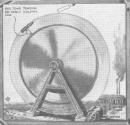
This is the second last chapter in the book, Good to Great, and it was actually one of my favourites. I enjoyed the concept. The concept being:
- Good-to-great (g2g) transformations often look dramatic, revolutionary events to those observing from the outside, but they feel like organic, cumulative processes to people on the inside.
- No matter how dramatic the end result, the g2g transformations never happened in one fell swoop. There was no single defining action, no grand program, no one killer innovation, no solitary lucky break, not miracle moment.
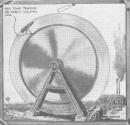
- Sustainable transformations follow a predictable pattern of build-up and breakthrough. Like pushing on a giant, heavy flywheel, it takes a lot of effort to get the thing moving at all, but with persistent pushing in a consistent direction over a long period of time, the flywheel builds momentum, eventually hitting a point of breakthrough.
- The comparison companies tried to create a breakthrough, instead of slowly generating momentum. They lurched back and forth, failing to maintain a consistent direction. This was the Doom Loop.
- Those inside the g2g companies were often unaware of the magnitude of their transformation at the time. Only later, in retrospect did it become clear. They had no name, tag line, launch event, or program to signify what they were doing at the time.
----
I learned from this chapter to just keep going in doing the right things, instead of being worried about creating some sort of quick program to become great. Just keep pushing on the flywheel and let its momentum build up!
Friday, February 17, 2006
Technology Accelerators
- Good-to-great (g2g) companies think differently about technology than do mediocre companies.
- G2g companies avoid technology fads and bandwagons, but are pioneers in carefully selected technologies.
- The key question is whether or not a specific technology fits into your Hedgehog Concept. If yes, then you need to be a pioneer in it; if not, then you can settle for parity or avoid it altogether.
- G2g companies use technology as an accelerator of momentum, not a creator of it.
- G2g companies react to technology change with thoughfulness and creativity, driven to turn unrealized potential into results. Mediocre companies react, motivated by fear of being left behind.
Thursday, February 16, 2006
A Culture of Discipline
Today I read the chapter in Good to Great titled "A Culture of Discipline". Here are some of the main ideas:
-Sustained great results depend upon building a culture full of self disciplined people who take disciplined action, fanatically consistent with the three circles.
-A culture of discipline involves duality. On the one hand, it requires people to adhere to a consistent system; yet, on the other hand, it gives people the freedom and responsibility to do their job within the larger framework
-The most important form of discipline for sustained results is fanatical adherence to the Hedgehog concept and the willingness to shun opportunities that fall outside the three circles.
-The fact that something is a "once-in-a-lifetime opportunity" is irrelevant, unless it fits within the three circles.
-The purpose of budgeting in a good-to-great is not to decide how much money each activity gets, but to decide which activities best fit within the Hedgehog Concept and should be fully funded and which should not be funded at all.
-"Stop doing" lists are more important than "to do" lists