
Wednesday, February 15, 2006

The Hedgehog Concept


This concept was one that I had heard of before reading this book. Our staff team in McGuelpherLoo was interested in implementing it to our ministry. So I will now explain what it is:
The Hedgehog Concept is a simple concept that flows from the deep understanding about the intersection of the following three circles...
1. What you can be the best in the world at (and what you cannot be the best at.)
2. What drives your economic engine,
3. What you are deeply passionate about.
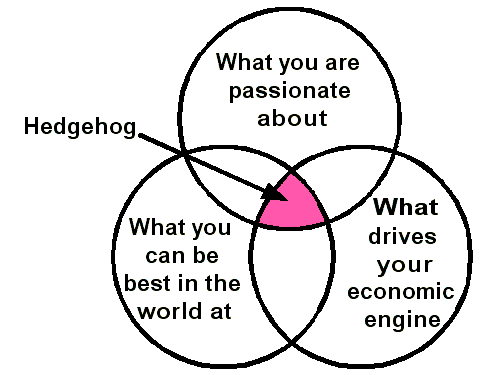
The reason it is called the Hedgehog concept is because of a trait that a hedgehog has. Everytime the hedgehog is attacked by a predator, it just rolls up into a little ball, and it is completely covered with spikes so that nothing can harm it. It doesn't try to learn new ways to protect itself; it doesn't need to. It has an effective way to protect itself and it sticks to it.

For ministry, the economic engine circle does not really apply. We would look at the concept in as far as the other 2 circles. For Campus Crusade for Christ, we find that our Hedgehog concept is Spiritual Multiplication. For those out there that don't know what that is, you will have to ask me later, or else I will head off in a huge tangent!

All in all, I think this is an effective tool for thinking about what your focus should be. I think it applies to not only companies, but ministries, and also individuals. Think about what you are passionate about, and what you can do really well, and do that! It seems simplistic, but in order to enjoy work and be effective over the long haul, it would seem to me that these 2 criterion are necessary.

Tuesday, February 07, 2006

Confront the Brutal Facts (Yet Never Lose Faith)

I read another chapter of Good to Great today. It was a good one, and by chance (who am I kidding, I don't believe in chance) one of my fellow CCC staff referred to this principle in a conversation we had today.

Here are some key points from the chapter:

All good-to-great (g2g) companies began their process to greatness by confronting the brutal facts about their current reality.

When you make the effort of confronting the brutal facts, the right decisions often become self-evident

g2g companies create environments where people have the opportunity to be heard, and so by default, the truth is heard

Creating a climate where the truth is heard involves four basic principles:

  1. Lead with questions, not answers
  2. Engage in dialogue and debate, not coercion
  3. Conduct autopsies (analyze a situation), without blame
  4. Build red flag mechanisms that turn information into information that cannot be ignored (allow people to bring up shortcomings before they leave because the situation hasn't been addressed)

G2g companies faced adversity, but they faced it head on, and then emerged from the adversity stronger

The Stockdale Paradox: Retain absolute faith that you can and will prevail in the end, regardless of the difficulties, AND at the same time confront the most brutal facts of your current reality, whatever they might be.

Charisma can be a liability as well as an asset in leadership, as your personality can deter people from bringing you the brutal facts.

------------

An interesting chapter... The key point from this seems to be the Stockdale Paradox. Being able to hold both faith and brutal facts at the same time. Sounds like a spiritual lesson as much, if not more than a business one.

Monday, February 06, 2006

A Biblical Call to Pursuing Godly Wisdom


I got back to reading When I Don't Desire God by John Piper today, after feeling the urge to read some good book after reading a post by Albert Mohler, who is the president of the Southern Baptist Theological Seminary (with such famous students as Uche Anizor, Chris Shipley, and the recently graduated Arvind Balaram). His post was basically responses to questions about reading. It is a great post, and if you want to read it click here.

Anyways, I found this chapter I read today very helpful. It was practical advice about "How to Wield the Word in the Fight for Joy". I was struck by many things, but this stood out as something that needs to be trumpeted to our generation:

I have the profound sense that many people who complain of not being able to
rejoice in God treat the knowledge of God as something that ought to be easy to
get. They are passive. They expect spiritual things to happen to them from out
of nowhere. They don’t grasp the pattern of the Bible expressed in Proverbs
2:1-6:

"If you receive my words and treasure up my commandments with
you, making your ear attentive to wisdom and inclining your heart to
understanding; yes, if you call out for insight and raise your voice for
understanding, if you seek it like silver and search for it as for hidden
treasures, then you will understand the fear of the LORD and find the knowledge
of God. For the LORD gives wisdom; from his mouth come knowledge and
understanding."

Look at all those aggressive words: “receive . . . treasure up . . . make your ear attentive . . . incline your heart . . . call out . . . raise your voice . . . seek . . . search”—if you do these, then knowledge of God will be yours. Not because you can make it happen. The giving of the knowledge is still in the hands of God: “For the LORD gives wisdom.” No, the pursuit of the knowledge of God is not because you can make it happen, but because God freely chooses to bless seeking with finding. The pattern is seen in 2 Timothy 2:7 where Paul says, “Think over what I say, for the Lord will give you understanding in everything.” You think. The Lord gives. Our thinking does
not replace his giving. And his giving does not replace our thinking.
I think we have a tendancy to be passive in our pursuit of God. We are used to being spoon-fed spiritual truths at church in Sunday, through a well packaged sermon (or maybe even a video...). But this passage from Proverbs states that we need to "seek it like silver and search for it like hidden treasures". If our only pursuit of the knowledge of God comes from a sermon on Sunday, and maybe the odd scripture reading and a 5 minute devotional, then we have failed the scriptural call to pursuing Godly wisdom. I count myself as an offender.

I hope that I can turn the corner in my own walk. One of the ways I want to do this is by memorizing Scripture. I will begin by doing a verse a day until I have memorized Romans 8. I hope that through this I can see and love and worship God in fresh and life changing ways, as well as be an encourgement to others to "lay aside every weight, and sin which clings so closely" and pursue Christ with all we have!

Wednesday, February 01, 2006

First Who...Then What

I finally got back to reading Good to Great. Today I read chapter 2 - First Who... Then What. I won't give a chapter summary as much as I will report what I think can be applied in my life.

Good to Great (g2g) leaders began the transformation by first getting the right people on the bus (and the wrong people off the bus) and then figured out where to drive it. The key point is not necessarily to just get the right people, but to ask the 'who' questions before the 'what' questions.

The comparison companies often used the "genius with a thousand helpers' model - getting one person to come up with the ideas and enlist capable helpers to make the ideas happen. As soon as the genius leaves, however, the model fails.

The g2g leaders were rigorous, not ruthless. They made tough decisions when needed in order to help the company and the individual, not just for the sake of a shake-up.

When in doubt, don't hire - keep looking.
Only grow as big as you have capable people to lead the growing number of employees.
When you need to make a people change, do it!
Before firing, make sure the employee isn't just failing because they are in the wrong job.
Put your best people in the biggest opportunities, not your biggest problems.

G2G management teams consist of people who debate vigorously in search of the best answers, yet unify behind decisions.

Compensation/rewards should not be used to motivate good things from the wrong people, but rather to get and keep the right people.

People are not your greatest asset. The right people are.

Whether or not someone is the "right person" depends more on their character than their skills or knowledge.

--------

I was struggling internally reading some of it, thinking about whether Christ would have looked at it this way. I think things like looking for character over skill is something Jesus would agree with. I also think that choosing the right people is generally a good concept. Jesus selected the 12 disciples out of many others who He didn't choose. We just have to watch our motives. I think that as a Christian leader I have to be concerned with the development of the person as much as if not more than picking the right person to do the job best. It is interesting that in the Discipleship group I lead a Guelph we are reading "The Masterplan of Evangelism", and just looked at the chapter on selection on the same day I read this chapter from "Good to Great".
Interesting...

Thursday, January 26, 2006

Rob Bell - Hip Dude with Cool Videos But Be Wary!


Today I came as I was checking out a blog I frequent, I came accross a book review of Velvit Elvis: Repainting the Christian Faith by Rob Bell. I was quite interested to see what it said because I had seen one of Rob Bell's videos and saw his book in a store. For those of you who do't know Rob Bell, he is a the kind of guy who puts the 'hip' in discipleship. He's got the bleached blond hair, the post-modern coffee house intellectual glasses, etc.

Anyways, the book review brought up 5 problems with Bell's writing. All 5 being in conflict with what the Bible says.

1. His View of the Bible as metaphor
2. His Understanding of the Christian Faith
3. His View the Nature of Sin
4. His View of God’s Faith in Man
5. His view of the Nature of the Atonement

The most scary was Bell's view of God's faith in man. Here is is a quote from the book review with the Bell's words in italics:

The self-ward bent of Bell’s teaching continues when he speaks of God’s
faith in man. Bell adopts his self-professed rabbi Ray VanderLaan’s teaching
that Jesus chose his disciples just like every other rabbi of his day - because
he believed in their innate abilities. In one of the most painful parts of the
book, Bell reminds us of the story found in Matthew 14:22ff. where Peter rushed
out of the boat to meet Jesus walking on the water. Peter began to sink and
Jesus rebuked him for his lack of faith.

“Who does Peter lose faith in? Not Jesus; he is doing fine. Peter loses
faith in himself. Peter loses faith that he can do what his rabbi is doing. If
the rabbi calls you to be his disciple, then he believes that you can actually
be like him. As we read the stories of Jesus’ life with his talmidim, his
disciples, what do we find frustrates him to no end? When his disciples lose
faith in themselves.....Notice how many places in the accounts of Jesus life he
gets frustrated with his disciples. Because they are incapable? No, because of
how capable they are. He see what they could be and could do, and when they fall
short if provokes him to know end. It isn’t their failure that’s the problem,
it’s their greatness. They don’t realize what they are capable of....God has an
amazingly high view of people. God believes that people are capable of amazing
things. I’ve been told I need to believe in Jesus. Which is a good thing. But
what I’m learning is that Jesus believes in me....God has faith in me.”

In fact, according to Bell, God has such great faith in the abilities
of men that Jesus “left the future of the movement (the church) in their hands.
And he doesn’t stick around to make sure they don’t screw it up. He’s gone. He
trusts that they can actually do it.” This is a shocking reinterpretation of the
Christian faith. When the gospel becomes the message of God coming to earth and
dying on a cross to help men believe how great they really are--something is
horribly amiss. This has the stench of blasphemy.


I completely agree that this has the stench of blasphemy. According to the Word of God in 1 Corinthians 1:26:

Brothers, think of what you were when you were called. Not many of you were wise
by human standards; not many were influential; not many were of noble birth. But
God chose the foolish things of the world to shame the wise; God chose the weak
things of the world to shame the strong. He chose the lowly things of this world
and the despised things and the things that are not to nullify the things that
are, so that no one may boast before him. It is because of him that you are in
Christ Jesus, who has become for us wisdom from God that is, our righteousness,
holiness and redemption. Therefore, as it is written: "Let him who boasts boast
in the Lord."

With all this in mind it must be said that when I first saw the video with him, I enjoyed it. I think it had a great message. I guess this just shows that we need to be careful. Just because a guy has a cool video or two doesn't mean that we should listent to his every word.

Another thing that came to mind was that because the video I saw was cool and hip and had emotional music, it had more effect on my emotions as opposed to my head knowledge. For instance, if a 60 year old preacher in a suit on Sunday morning gave the same message, it would not have had the same impact. Maybe guys like John Piper and D.A. Carson should give their sermons with cool music and just casually talking while walking towards the camera and more people in the post-modern mindset would appreciate it. I guess this goes to show that the medium has a large effect on the message.

If this has interested you I encourage you to read the whole review, which is linked at the top of this post.