Wednesday, November 09, 2005

Fighting for Joy like a Justified Sinner


One of the other books I have been reading recently is John Piper’s When I Don’t Desire God: How to Fight for Joy. I haven’t been reading it as deeply as I probably should in order to get the full profit from reading it, so I decided to do a blog on one of the recent chapters so I could allow it to sink in a little deeper. The chapter is called “Fighting for Joy like a Justified Sinner”

One of the main points of this chapter was to learn the fact that we need to preach the gospel to ourselves regularly, and especially during times when we are going through a wilderness time in our walk with God. What I mean by this is that we need to constantly go back to verses that talk about how God has transported us from the Kingdom of Darkness unto the Kingdom of Light. God made us, sinners who deserve judgment into justified sons and daughters.

One of the things that cause us as Christians to distress is confusing justification and sanctification. Justification is the immediate act when we become Christians that takes us out of God’s judgment. We are immediately in perfect standing legally before God. Sanctification, on the other hand, is the process we go through in this life of becoming holy. It is a process and will not be complete until with are with the Lord in heaven. Piper says this about the difference:

Both are gifts, and both are bought by the blood of Christ. They are inseparable
but different. Both are by faith alone. Justification is by faith alone because
only faith receives the declaration that the ungodly is counted righteous.
Sanctification is by faith alone because only faith receives the power to bear
the fruit of love. It is crucial in the fight for joy that we not confuse or
combine justification and sanctification. Confusing them will, in the end,
undermine the gospel and turn justification by faith into Justification by
performance. If that happens, the great gospel weapon in the fight for joy will
fall from our hands.

In the next section of the chapter he speaks about “becoming what you are”. As Christians we are justified. Now we need to see ourselves as justified:

One of the ways the Bible talks about our action in relation to our standing in
Christ is to command us to become what we are. For example, using Old Testament
ceremonial language Paul says, “Cleanse out the old leaven that you may be a new
lump, as you really are unleavened” (1 Cor. 5:7). In other words, become what
you are. You are unleavened (sinless in Christ); therefore become unleavened
(sinless in practice).


I think this simple truth really ministered to me. I don’t have to do something on my own to earn anything. I am simply becoming what I already am in God’s eyes. And it is not like after being justified by faith alone we now need to become sinless on our own. We just need to be progressively becoming more and more obedient and less and less sinful in the power and strength that God provides through faith.

The chapter goes on to talk about how Micah fought for joy and various other things, but this is the part that really ministered to me. I am thankful to God for John Piper and is writings and how God has used him to help many Christians around the world take their joy in Christ.

Monday, October 31, 2005

Habit 2 - Begin with the End in Mind

The chapter began with the author asking the reader to picture themselves at their own funeral. Then to imagine what the reader would want the people giving the speeches to say about them. When you come up with what you would want said about yourself, you see what are the most important things to you. These are the things you should be making sure you accomplish in life.

If you begin with the end in mind, you can make sure, on a day-to-day basis that what you are accomplishing during your day is actually something that is important to you.

One of the most important things I took from this chapter so far is the fact that you can busy yourself with many things, but it doesn't necessarily mean that you are being effective. The world will give you many things to keep busy with, but unless you keep a tab on what you are doing and making sure that it is in line with your end goal, you could busy yourself with many things that don't really matter.

Beginning with the end in mind is based on the principle that all things are created twice. For example in construction, the architect builds every detail of the building on paper before a single nail has been hammered in. It is the same thing with our lives; if we do not plan ahead as to what we want to be accomplishing, we by default empower other people and circumstances to shape our lives. We will be constantly reacting to things around us instead of proactively makings sure that we are the architects in our own lives.

Beginning with the end in mind is a practice of personal leadership. Leadership works at directing the ship, whereas management makes sure the rowing is being done effectively. If we are not leading out in the direction we want to go, it doesn't matter how good managers we are, as we will only be effective in going in the wrong direction. Effectiveness does not depend solely on how much effort we expend, but on whether or not our efforts are focused on going in the right direction.

We need to make sure we have clarified our values and goals before we start expending energy and efforts that could possibly be leading us in the wrong direction. One way we can make sure we are always effectively moving in the right direction is by creating a personal mission statement. With this statement, we can compare our actions on a regular basis to what we have written as our most important goals.

Friday, October 28, 2005

Habit 1 - Be Proactive


Recently I have begun reading the book The 7 Habits of Highly Effective People by Stephen Covey. I have realized that one area I want to grow in is Leadership, and so I have been recommended 4 books, all of which I have to goal to read by Christmas. The 7 Habits of Highly Effective People is the first book on that list.

In this book, the author tells the reader to read the book as if you are going to be teaching the content of the book shortly after. In this way, you will take more from the book than if you were just reading it for leisure. So I intend to report on each of the 7 habits, for you, my class J. Of course, what follows is just a short “Coles notes” of the chapter. You will be missing the helpful analogies, stories, etc. But hopefully you will get the basic gist of it. Maybe it will whet your appetite to read the book yourself. So far I recommend it!

Habit 1 – Be Proactive

We as humans are not our feelings. One thing that separates us from the animal kingdom is that we can “step outside” ourselves, and look at our paradigm (how we see things).

There is a theory that says that our lives are determined by three things: Genetic determinism (Our DNA), Psychic determinism (The way our parents formed us growing up), and Environmental determinism (the people or situations around us). When we are confronted by a stimulus, we will respond in a certain way because of the three determiners. For example, when someone cuts us off on the highway, we will react in this certain way; or when we receive a gift, we will react that way. This is called the stimulus/response theory. Is this theory correct?

A guy named Victor Frankl discovered during the holocaust (he was a Jew in the Prison camps) that even among the most horrific circumstances, that he had a choice whether what was happening around him would determine his mood. He discovered a fundamental principle about man, that in between stimulus and response, man has the freedom to choose. It is not what others do to us or even our own mistakes that hurt us the most; it is our response to those things.

Proactivity defined is that we as human beings are responsible for our own lives. Our behavior is a function of our decisions, not our conditions. We can take what happens around us, good or bad, and not let our feelings or emotions determine our decisions. We have the initiative to make things happen. Look at the word responsibility – response ability – the ability to choose your response. Highly effective people do not blame their circumstances or conditions. Their behavior is a result of their own conscious choice.

Many people wait for things to fall into their laps. In this way, they act reactively. This limits them to their surroundings or conditions. People who have made a great difference in the world, conversely, act proactively regardless of their circumstances.

Anytime we think that the problem is “out there”, that thought is the problem. By blaming things that are “out there” we allow what is “out there” to control us. The proactive approach is to change from the inside-out: to be different, to be more resourceful, to be more diligent. We need to look at what we can control rather than what we cannot. If I really want to change the situation, I need to work on the one thing I have control over – myself.

Monday, October 24, 2005

Heavy thoughts...

At my church in Kitchener we are going through "40 Days of Community" which is the follow-up to "40 Days of Purpose" from the famous book The Purpose Driven Life. For each of the 40 days you have a reading to go through. I just wanted to share part of yesterday's:

"Love cares about the destiny of others. If you knew the cure for cancer or AIDS, and you kept it as secret, telling no one while millions continued to die, would that be loving? Of course not, If you knew the key to extending human life by 50 years, would you want to share it with others? Of course you would. But as believers (Christians) who've learned the way to eternal life, we have an even more important, longer lasting, and urgent message to share with the world, and love leaves no choice"

What the author is saying is that as Christians, we believe that we have the most important cure in the world. The effects of sin on a human has eternal consequences, while the effects of AIDS are temporary. With this in mind, is a Christian a loving person if they don't share their faith. I mean, if they are honest with themselves, they believe that if people don't have Christ, they are going to be in Hell when they die. Sometimes we like to sugarcoat this fact with phrases that are more pleasant such as "eternity apart from God", but the reality is no Christ = Hell.

As a Christian, this is a devistating fact to ponder. I can do all the nice things in a world, but if I don't tell a person about Christ, have I really showed them love? Maybe in some ways, but ultimately not.

The way I see it, if a person's house is burning down while they are sleeping inside it, knitting that person a sweater might be nice, but it would be far more important and loving to wake them up and get them out of the house.

Monday, October 17, 2005

Leafs Rule, Habs Drool!!

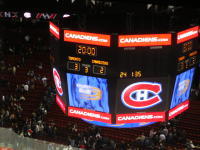
So as I mentioned in my previous post, Vanessa and I went to the Leafs-Habs game in Montreal last Saturday (Oct. 15). It was an awesome game to be at. The Bell Centre is really big (about 22,000 compared to the ACC at 18,800). We were up in the nosebleeds but the seats weren't that bad as we were right on the goal line.


We were sitting right behind another pair of Leaf fans. This guy probably spent $100 in mostly beer for him and his girlfriend. He also bought a $6 Canadiens flag which he doubled as both a foot rest (see picture), as well as a cloth to wipe excess beer from the side of his cup. Although I thought he was funny, when he asked me to step on the flag I declined. Even though I hate the Habs, there is still a respect about another teams crest.


One of the coolest things about being Leafs fan is being part of something that is so huge. At the Bell centre there was probably at least 25% Leafs fans that made the 5-6 hour drive to Montreal. When the Leafs scored it was so awesome as it was just about as loud as when the Habs scored (minus the Bell Centre horn and music). Pretty much the whole row behind us was Leafs fans. This picture was taken after Lindros got his second which turned out to be the game winner. What made it even more sweet was that everytime Lindros touched the puck the all the Canadiens fans booed. When Lindros scored (twice) they were so sad. I'm sure they were thinking "Ah zut". I love it!


Final Score: Leafs 3, Habs 2. Leaf goals by Allison, and Lindros (2). As you can see in the penalty summary the Leafs ended the game with McCabe in the box. The last few seconds were so frantic as the Habs also pulled their goalie so the last 25 seconds were 6-4. Luckily for us Eddie the Eagle came up big. I love that guy!


So the happy couple left the Bell Centre smiling like the cat who caught the canary. We actually bought each other the tickets as birthday presents for each other. We stayed with friends who live a 15 minute walk from the Bell Centre so it was perfect! (Thanks Andy and Loni).

So ends the trip to Montreal. If any of you have ever wanted to see a game at an opposing teams rink/stadium, I wholeheartedly reccomend it. Especially if you are Leaf fans, because you know that no matter what rink you are in you will not be alone!

Go Leafs Go!